Two wayside crosses returned to their sites of discovery
Andrew G. Langdon (Dyffresyas Crowsow), Wadebridge OCS
This note reports on the restoration and re-siting of two wayside crosses, which until recently had no public access, but which now have been set up on grass verges with full public access. The crosses are Tregoodwell Cross in Lanteglos by Camelford parish and Fursnewth Cross in St Cleer parish.
Tregoodwell Cross, Lanteglos by Camelford
Discovery and history: In 1891, this cross-head was discovered when a section of hedge was removed at a field on Tregoodwell Farm to create an entrance to the new Camelford Football Field. The football field was at SX 1127 8383, opposite the road junction where the Roughtor Road and Higher Cross Lane converge. When Arthur G. Langdon visited Tregoodwell prior to writing his book Old Cornish Crossesin 1896, the cross-head was found sitting on top of an old Camelford Borough boundary stone at the junction of the two roads. The hedge has since been removed to improve vehicle visibility, but the boundary stone still survives and can be seen set in the foot of the grass verge.
The cross-head was removed into Lanteglos by Camelford parish church for preservation during the incumbency of Revd. J. J. Wilkinson (1911 and 1914). Here it lay on the floor of the church with several other fragments of carved stone for many years. During 1997, the North Cornwall Heritage Coast and Countryside Service (part of the old North Cornwall District Council) held discussions and drew up plans in the hope of returning the cross to Tregoodwell. At this time the cross-head was removed into the bottom of the tower for more security and remained there until 2012 because the project did not go ahead. The monument was microchipped in December 2008.
Although the monument’s original position is not known, it has been assumed that the cross may be close to its original site and that it probably marked a route from Lanteglos by Camelford church to Davidstow church. Here at Tregoodwell, it may have pointed the way along Tyland Lane to Tyland Corner near the old Davidstow airfield and on to the parish church. The cross is also on the borough boundary – a boundary which may date to the foundation of Camelford borough in 1259.
Description and dimensions: This is one of the smallest wheel-headed wayside crosses in Cornwall. It displays a relief cross with parallel arms on each face, which extend to the edge of the stone. The arms on the reverse face are irregularly placed.
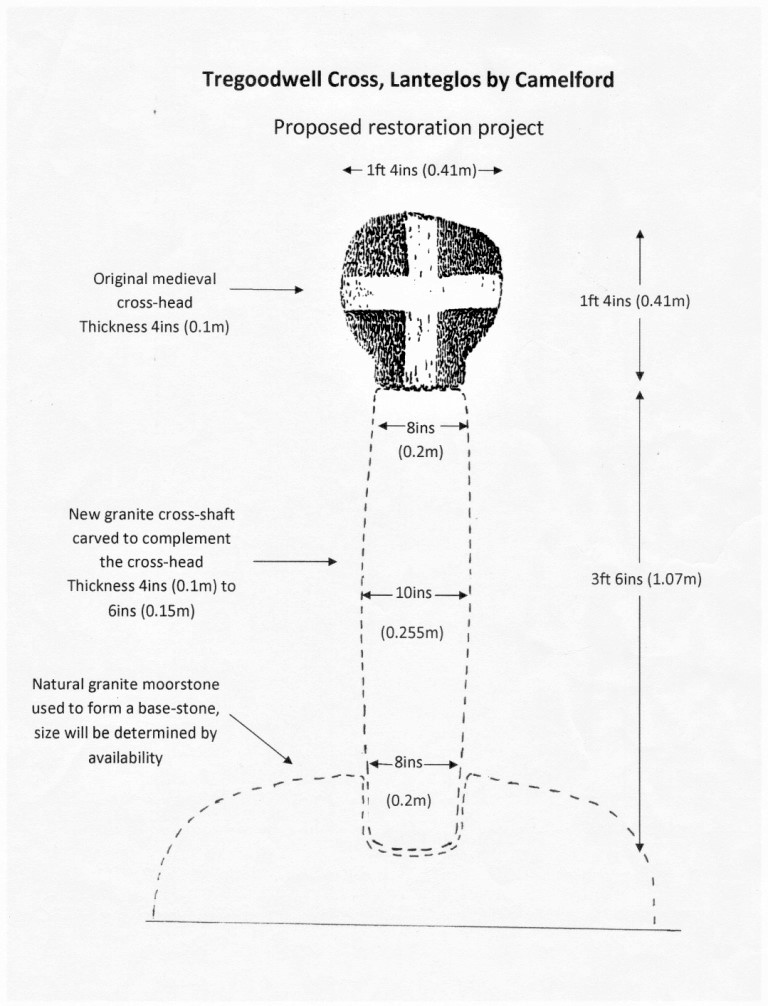
Height of cross-head 0.41M (1ft 4ins), width also 0.41M (1ft 4ins) and thickness 0.1M (4ins).
Plans to restore the cross: In 2011, Mrs Nancy Lane of Tregoodwell suggested resurrecting the project to return the cross. Mrs Lane’s late husband Harold had always wished for the cross-head to be brought back to Tregoodwell village, and she hoped that a new project could be organised in memory of her husband who died in 1996.
The plan in 1997 had been to set the medieval cross-head on a new, specially commissioned, shaft and base cut from granite which matched the original as closely as possible. Drawings made for this in 1997 (Fig. 1) were revived and once permission had been obtained to restore the cross, stonemason Mr Ernie Hillson who had been involved in former plans was contacted again and volunteered to carve the new cross-shaft.
Support was obtained from Camelford & District Old Cornwall Society along with local parishioners at Tregoodwell, including Mr and Mrs Walker who owned the property directly behind the proposed site. Although the Parochial Church Council was supportive of the project, a faculty was nonetheless required from the diocese for permission to release the monument. Permission was also sought from Cornwall Council’s highways department since the proposed site might affect visibility at the road junction in Tregoodwell. With overall agreement to the project in place, plans for the restored cross were drawn up and a faculty application submitted to the diocese in November 2011. The Faculty was granted in March 2012 and the cross-head was released by Mr Menear the churchwarden during April 2012.
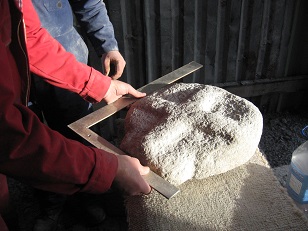
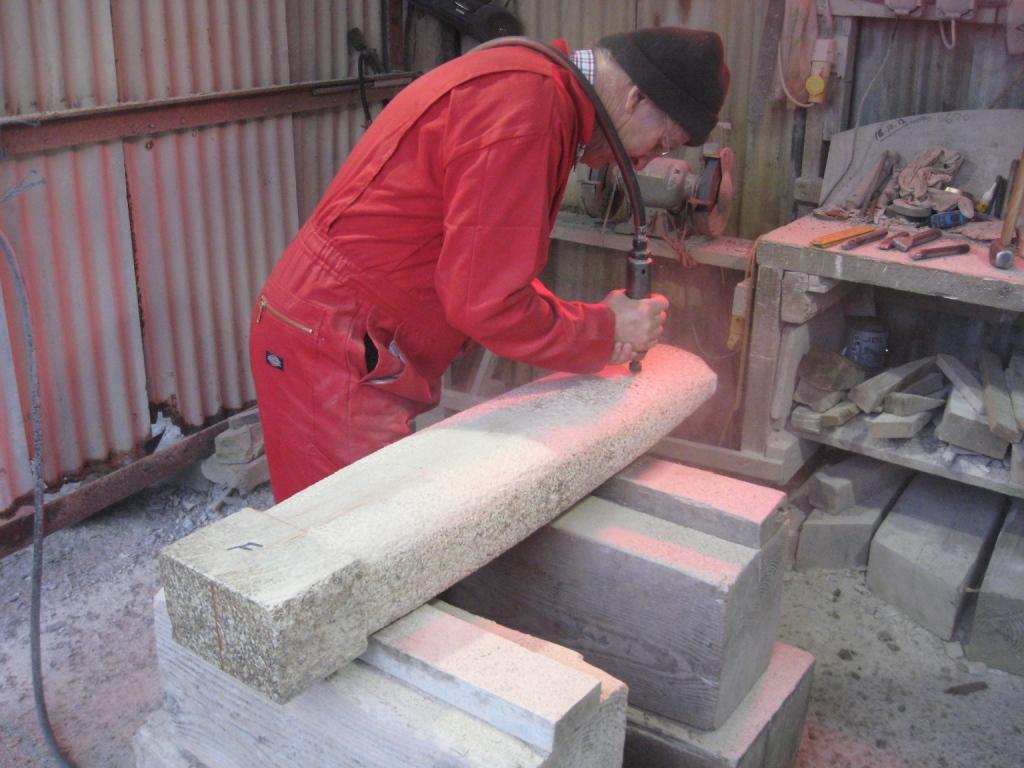
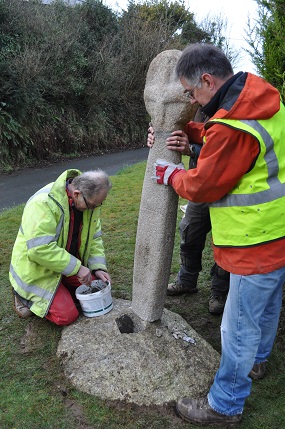
Restoration: Stone suitable for the new shaft and base-stone was obtained from Trenoweth Quarry at Mabe Burnthouse and was donated free of charge by the quarry owner Mr Tim Marsh. Work began on carving the new shaft for the cross-head in November. A piece of brown ‘grass rock’ (surface granite) was carved at Trenoweth by Mr Hillson (Fig. 2). At the same time, a weathered granite boulder considered suitable for the base-stone was identified and a mortice cut in the top to receive the cross-shaft. Later, the three portions of monument: the original head (Fig. 3), new shaft and new base-stone were removed to Mr Hillson’s workshop at Lanow in St Kew parish, where the cross-head was pinned and glued to the new cross-shaft and the whole monument set up in the workshop prior to being erected onsite.
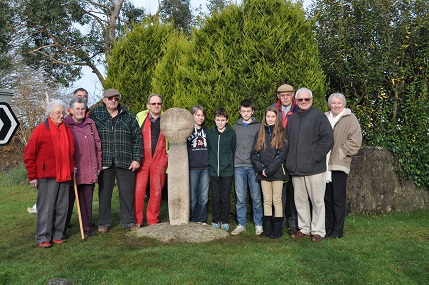
Re-siting: On Saturday 26th January 2013, the cross and its new base-stone were transported to Tregoodwell where the monument was set up on the grass verge by Ernie Hillson, assisted by his son Kevin, with Mark Andrew supplying a mechanical loader to lift the stones into place (Fig. 4). The event was witnessed by Mrs Lane and many local residents and was also filmed by BBC Southwest ‘Inside Out’ programme. The cross, which in its restored state stands 1.5M (4ft 11ins) high, now forms an interesting feature beside the road to Roughtor at SX 1121 8381. (Fig. 5 – Tregoodwell residents beside the cross).
Please click on the images below for larger views
Fursnewth Cross, St Cleer
Discovery and history: The Fursnewth Cross was discovered during the late 1920s at Great Fursnewth in St Cleer where it had been used as a support for a mowhay or barn. This use resulted in a ‘V – shaped’ slot being cut in the top of the wheel cross to support a timber beam. The cross had also previously been used as a gatepost and the remains of an iron gate-hanging still survived in the shaft. According to Croft Andrew, the cross had also been used as a bearing for a piece of machinery.
Soon after the cross was discovered it was acquired by Mr Albert de Castro Glubb (1865-1947), a Liskeard solicitor and former President of Liskeard Old Cornwall Society (OCS),who removed the cross to his residence at Pendean in Liskeard, where it was set up as a landscape feature in his garden at SX 2488 6461. Here the monument stood until the end of January 2013.
The minute books of Liskeard OCS record that although the cross was shut away in a private garden, it was never forgotten. A letter written by Mr C. K. C. Andrew on 24th July 1947 stated that the executors of Mr Glubb’s estate had given permission for the cross to be removed from Pendean. As a result, Liskeard OCS discussed the possibility of re-siting the cross with the County Surveyor in October 1947, but no action was taken. During March and April 1970 the question of re-siting the cross was raised as a possible project to celebrate the Federation of Old Cornwall Societies’ Golden Jubilee Year and was raised again several times in 1974.
Mrs Angela Redman, present owner of Great Fursnewth, became aware of the cross and its origin in the 1990s and requested help from the writer in 1994 and 1997 to repatriate the cross to St Cleer. However at the time, the logistics of organising a voluntary project to shift this cross were considered too much – it needed funds, professional help and equipment.
Description and dimensions: The cross is complete, except for its base-stone. It was originally a wheel-headed wayside cross with an equal armed cross in relief on both faces. Today it is somewhat battered with a V shaped segment missing from the top of the head and the worn remains of an equal armed cross in very low relief on each face. Prior to the project, there was an iron fixing in the face of the shaft and the cross on the reverse face had been almost worn away, indicating that at some time during its long history, it may have been recumbent and walked over.
Height 1.68M (5ft 6ins), width of head 0.49M (1ft 7 ½ins), width of shaft varies between 0.34M and 0.31M (1ft 1 ¼ins and 1ft ¼ins), thickness 0.21M (8 ¼ins).
Plans to restore the cross: During 2010, Iain Rowe of the Caradon Hill Area Heritage Project (CHAHP) which was funded by the Heritage Lottery Fund suggested that their project may be able to fund the removal of the cross from Pendean House back to Fursnewth and preliminary investigations took place to see if this was possible. On gaining access to the monument which was shrouded by large shrubs, it was found that on the reverse face of the shaft, the remains ofthe old iron gate-hanging had corroded, expanded and cracked the shaft on three sides. At first this rather thwarted the plans to re-site it. However as the cross is a Scheduled Monument, and at high risk of damage due to the crack in the shaft, Ann Preston-Jones from the Historic Environment, Cornwall Council was able to help fund the repairs to the cross through the Scheduled Monument Management Project, which is funded by English Heritage, Cornwall Council and the Cornwall Heritage Trust.
A plan was put together, with the Historic Environment’s Scheduled Monument Management Project funding the repairs and the CHAHP funding the monument’s removal from Liskeard to Fursnewth, St Cleer.
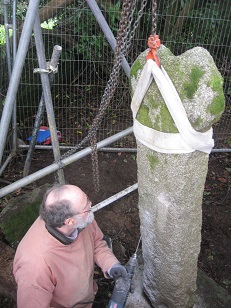
Restoration: On Thursday 31st January 2013, stonework conservators Sue and Lawrence Kelland examined the cracks in the cross-shaft and found that these could be repaired in-situ before the cross was taken down. The original plan had been to break the shaft at the crack, remove the cross in two sections and later glue and pin the two sections back together again. However the Kellands’ revised plan was accepted as a more sympathetic approach and they drilled diagonal holes into the shaft across the crack, two through the face of the shaft and one across the side of the shaft. 6mm stainless steel bar was then inserted through the cracked areas and glued into position, strengthening and securing the crack (Fig 6).
Once the crack in the shaft had been secured, the weight of the monument was supported by a block and tackle from a scaffold which had been erected around the cross, and the mortar was painstakingly chipped away from the bottom of the shaft where it was fixed into the base-stone. Once loose, the cross was carefully lowered down ready for collection by Monumental Mason Ian Piper and his team from C. F. Piper & Son of Bearah Tor Quarry, North Hill.
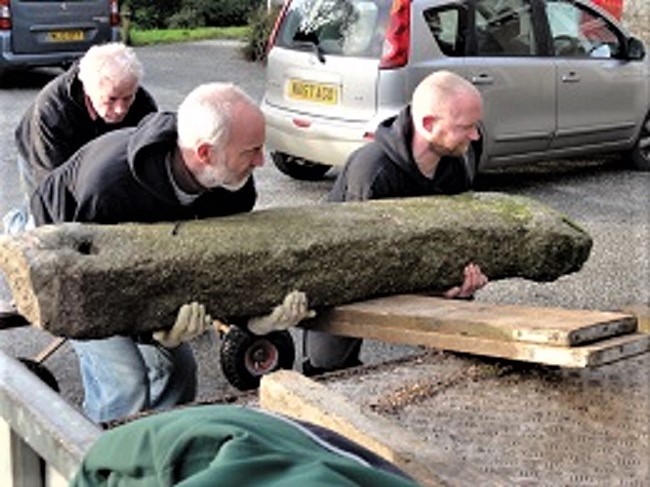
Removal from Liskeard: - This took place on Monday 4th February, when Ian Piper, Alex Piper and Peter Hooper collected the cross from the garden at Pendean and transported it to Bearah Tor Quarry for fitting the new base (Fig. 7).
New base-stone:- A suitable granite boulder was selected from stone at Bearah Tor Quarry, for Mr Piper to convert into a cross-base. The top surface of the weathered granite boulder was ideal but needed the bottom trimmed as its thickness was irregular. Once trimmed, a mortice was cut into its top large enough to support the shaft of the cross.
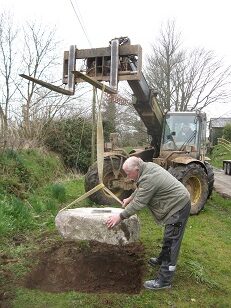
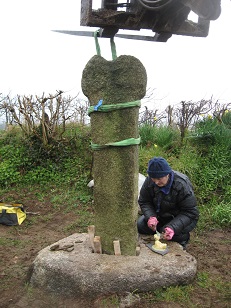
Re-siting the cross at St Cleer: - On Monday 25th March, Mr Piper transported the cross, together with its base-stone, back to Fursnewth. Here the base-stone was set in place by Mr Piper with the help of Mr Toby Rogers from neighbouring Trelethick Farm, using a mechanical loader (Fig. 8). Sue and Lawrence Kelland finally erected the cross on its new base on Wednesday 10th April, again with the assistance of Toby Rogers. The shaft was fixed into its base-stone using a polyester resin and the joints filled in with a lime mortar coloured to match the granite (Fig. 9). The cross was also microchipped and fully recorded as a deterrent against theft. The cross, which now stands at SX 2253 6744 now forms an impressive feature on the roadside verge directly opposite Great Fursnewth manor house.
Dimensions of restored cross: Base-stone 1.3M (4ft 3ins), by 1.04M (3ft 5ins), thickness varies between 0.2M (8ins) and 0.29M (11 ½ins). The mortice measures 0.37M (1ft 2 ¾ins) by 0.25M (10ins), depth 0.2M (8ins).Height of the cross above the base-stone 1.55M (5ft 1in).
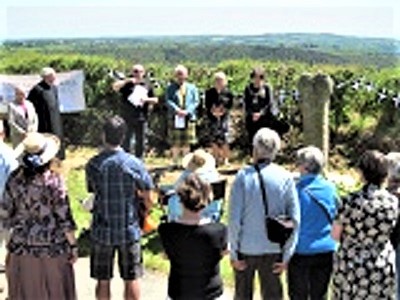
Re-dedication: The cross was officially re-dedicated on Tuesday 4th June by the Revd. Keith Lanyon-Jones, vicar of St Cleer amidst a party atmosphere. Local residents Angela and John Redman arranged a folk music group on the front lawn of their house, and with neighbours organised food and drink for the occasion. The area around the cross was decked with St Piran’s flags and bunting and a small marquee was erected to house an exhibition about the cross restoration work.
The re-dedication ceremony was organised by Duncan Matthews, President of Liskeard Old Cornwall Society and also President of the Federation of Old Cornwall Societies; guests included Maureen Fuller the Grand Bard of Gorsedh Kernow, Sue Pike the Mayor of Liskeard, Debra Atkins manager of Pendean House and Derris Watson, Cornwall Councillor for the St Cleer area (Fig. 10).
Conclusions: In both cases it has taken many years for these projects to come to fruition: however, it has proved well worth the wait as they are now both restored as features in their original settings, and are now both publicly accessible and well cared for by their local communities.
Acknowledgements in additions those named in the text:
Tregoodwell Cross – Mr Rod Keat, Chairman Camelford and District Old Cornwall Society, Rebecca Dickson, Cornwall Council Highways Manager, Revd. Jim Benton-Evans, rector of Lanteglos by Camelford, churchwardens, Mr H. Menear and Mrs B. Oliver, and Mr Colin Lane.
Fursnewth Cross – Debra Atkins and staff at Pendean House, Mr Roger Tamblin of Trelethick Farm, Jane Uglow of CHAHP, members of Liskeard Old Cornwall Society and local residents in the hamlet of Fursnewth..
Finally to Ann Preston-Jones, for reading through and editing these notes.
Please click on the images below for larger views
Originally published in Kernow Goth journal :
Should you wish to see the contents of this journal, click the above link, which will open a new window. This journal is available to buy through our shop
