The Tower on the Beacon St Agnes by Clive Benney
But why was it there?
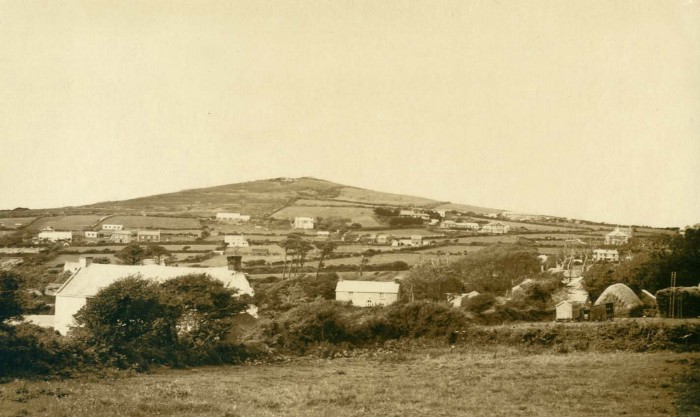
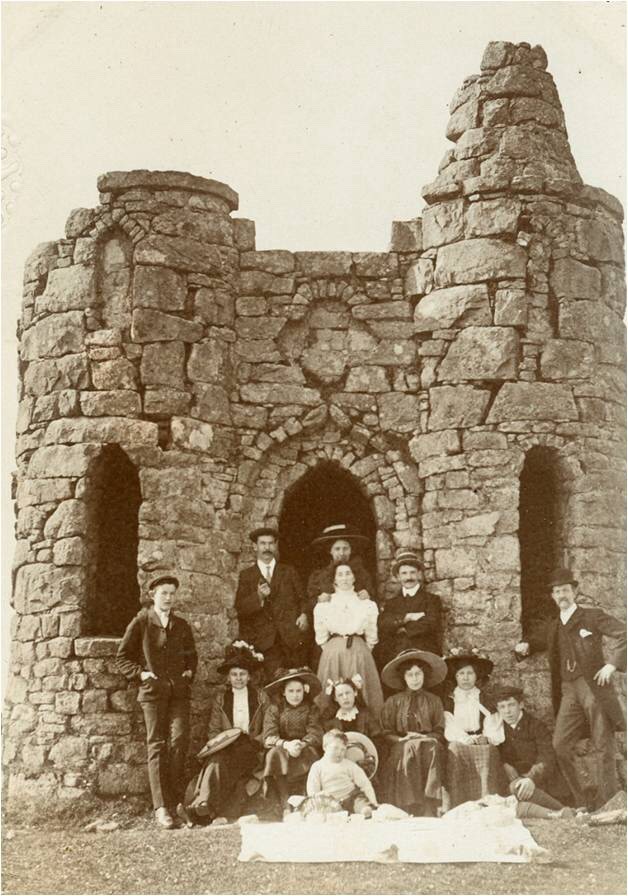
There was for a short time at the end of the eighteenth and beginning of the nineteenth centuries, what has been described as a castle, tower or summer-house, on the top of the Beacon. At this time, it must have been a striking and dominating feature of the landscape, yet little is known of it today. Although documented there are no published close-up drawings.
It is not known when the tower was built, but it may have been there in 1796 when St Agnes Beacon was first used as a survey station by the Ordnance Survey. The trig point is on lower ground to the south; presumably because there was some structure preventing use of the more logical, higher position. In 1806 Lysons mentions the ancient cairn with a beacon on it and a summer-house built near “from which is a fine view to St Ives”. This tells us that the tower was built for pleasure and not a military monument.
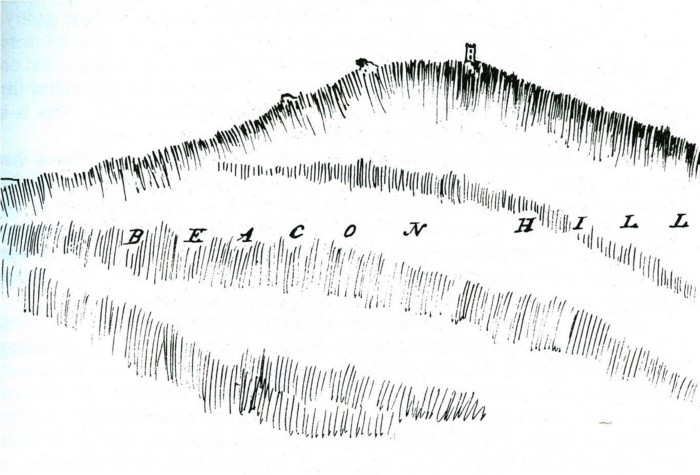
In the Plan and Sundry Lands in St Agnes, the Property of the Late John James of Rosemundy, 1814 (Kresen Kernow CAR/1/23) a pen and ink drawing of the Beacon forms a backdrop to the plan of fields and cottages from Mingoose to Rosemundy. On the top of the Beacon is a squat but two-storied tower with crenelations, door and window.
On the 13th and 20th March 1812, the West Briton newspaper published the following notice:
10 guinea reward offered by Matthew Sylvester for anyone supplying information on the person who broke open the summer-house called Donnithorne and Unwin’s Castle, broke and carried off the window frames, and broke floors and doors.
The following entry in the Royal Cornwall Gazette newspaper of the 16th January 1813 gives us a further description:
A piece of land, situate at St. Agnes aforesaid, containing two acres, whereon is erected an Edifice called Unwin’s Castle, held by virtue of an Indenture of Lease, bearing the date 18th September 1795, for the term of 99 years from Michaelmas, 1795. N.B. Unwin’s Castle is a Stone Pile, erected on one of the most prominent eminences in Cornwall; and is situate on the verge of the cliff adjoining St. George’s Channel; stands in height about four fathoms from its base, and stands about 155 fathoms above the sea.
The above suggests that the building was still standing at this time, however by 1817 an entry in the Cornwall Gazetteer refers to a summer-house on the Beacon a footnote records that it had been “blown or taken down since the report was printed”.
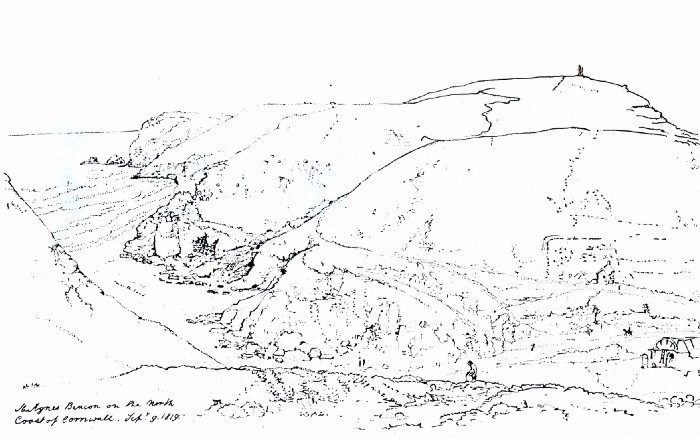
It would appear, however, that the structure was only partly ruined at this date, for a sketch dated the 9th September 1819 of Chapel Porth, with the Beacon in the background, shows a tall building on the top of the Beacon with what looks like a ragged and uneven top.
Fortunately, a little more is known of the summer-house. In J.T. Tregellas’ story of Mousey Cock ‘the great round pleasure-house’ up ‘Bickin Hill’ is one of the sights of St Agnes shown by Mousey to any visiting gentry. By the time Tregellas (1792–1863) was writing the pleasure house was no more than a memory and so in a footnote he added that “a round white tower stood on the top of Beacon Hill within the writer’s remembrance, which was called the Pleasure House; it was used for picnic parties”.
So why was it built? A clue comes from the above West Briton entries in March 1812 when it refers to ‘Donnithorne or Unwin’s Castle’. This suggests that it was either built by, or erected in honour, of two people of this name. Donnithorne and Unwin were in fact well known figures in St Agnes in the late eighteenth and early nineteenth centuries, the time when the tower was standing.
In the eighteenth-century historian Thomas Tonkin recorded that one of the principal inhabitants of this ‘little town’ was Nicholas Donnithorne who ‘by his industry and trade has risen a fair fortune’. The Donnithornes became the owners of Trevellas Manor and wealthy mine owners, involved particularly in the Polberro mines. From 1789, Nicholas Donnithorne had been the Chairman of the Cornish Association of Tinners, at a time when the slump in tin prices, due to a saturated market, was causing considerable concern. He appears to have been closely involved with introducing George Unwin to the Associated Tinners. Unwin, a former employee of the East India Company, suggested and negotiated a contract with the East India Company, who agreed to take a set amount of Cornish tin, at a fixed price, every year, the tin being exported to China where its was beaten into tin leaf and burnt on the shrines of idols. 600 tons of coined tin was exported annually. Between 1791 and 1795 the trade amounted to roughly £400,000. This had the immediate effect of raising the price of tin in Cornwall and in reducing the substantial stockpiles. The tower on the Beacon was built in honour of the men’s work and paid for by public subscription.
Before long, however, it turned sour, for while the tin prices rose locally, the East India Company continued to pay the price originally fixed. So, is there anything left of the summer-house to be seen now? In her article in the St Agnes Museum journal number 13, archaeologist Ann Preston-Jones wrote:
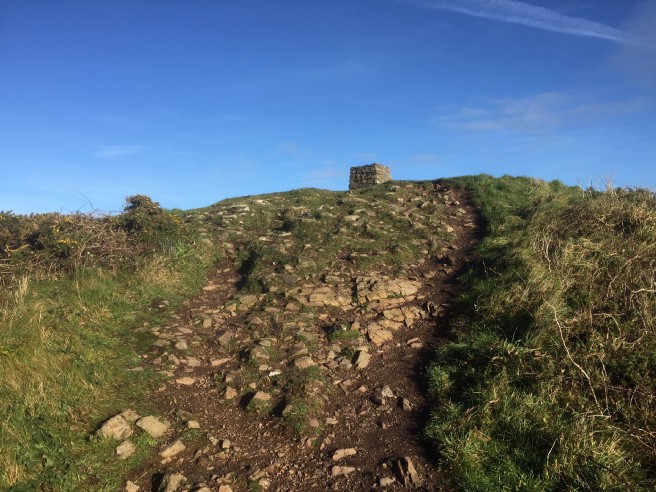
Careful consideration of all the evidence, a search of the top of the Beacon, and survey of significant piles of stone up there have led to the conclusion that the prominent mound on which the trig pillar is set may represent the ruined summer-house, itself perhaps built on the site of a Bronze Age barrow and beacon also occupying this commanding position.
Further information about the Tower and the Beacon can be found in:
The Journal of the St Agnes Museum Trust, No 13, ‘St. Agnes Beacon’ by Ann Preston-Jones.
St Agnes Beacon…Archaeological and ecological assessment. Cornwall Council Historic Environment Project, 2010.