St Ives Old Cornwall Society – Social Events & Meetings
16th March 2020
On this, the final meeting for the foreseeable future, Trelawny was played by Frank Stevens and sung with gusto.
Margaret Stevens, the President, explained that due to current health concerns, the St Ives Old Cornwall would not be holding the next two planned meetings on the programme for 2019-2020 and excursions and events being held by both our Society and the Federation are now cancelled or postponed until further notice. It was also stated that St Ives Museum will not be opening on the originally advertised date.
Trevor Peake was then welcomed as our speaker for the evening. Trevor is a member of the National Coastwatch institution here in St Ives which is based on The Island. The current lookout is on a rock known as ‘Lamp Rock’ as, due to its prominent position, in the 1600’s it was the site of a tall pole with a lantern on top which was used to guide the fishing boats into Porthgwidden Cove which was the main landing place at that time.
The Island was fortified in order to protect the town but in Henry V’s reign four French ships landed at Porthminster, sacked the village and destroyed the chapel. Lord Willoughby then built a fort on what was then known as Pendinas Head (or the Island) and canons were supplied. In 1801 James Halse, builder of Halsetown, set up a voluntary Infantry regiment armed with 6x18 pounders and 6x12 pounders which was under the command of Pendennis Castle, Falmouth. This was dismantled in 1815. In 1860 the granite battery walls to the south of the lookout were erected and the fort was re-armed, under the command of the Duke of Cornwall Light Infantry, in case of invasion by Napoleon III. Their barracks were the surf house which is now run by Tassy Swallow. In 1887 3x64 pounders with a circular radius were installed in order to cover the harbour, bay and Porthmeor approaches. These guns were removed in 1895. St Nicholas chapel had been used as an army store prior to its demolition in 1904 on the orders of the government. Edward Hain funded the rebuilding of it in 1911.
The first Coastguard Station in St Ives was built on Lamp Rock in 1945 but was closed in 1994. The National Coastwatch Institution (NCI), which is a non profit making organization, opened the St Ives station on 10th August 1999 and they have ‘Eyes Along the Coast’. The large map on display showed the sites of many lookouts: Cape Cornwall, Teignmouth and Exmouth are 3 of the 50 stations around our coast. The stations central control point is Falmouth Coastguard at Pendennis Head in Falmouth. Falmouth Coastguards co-ordinate British Shipping by liaising with other coastguards stations around the world. Training for the staff is to ‘SPOT/PLOT/REPORT’. Individual stations are unable to contact shipping directly but they inform Falmouth Coastguard or Harbour Masters of any potential incidents noticed during their watch. The RNLI play a very important part in the rescue operations which are initially reported by the NCI. The St Ives station is manned by 57 trained volunteers, who come from all walks of life, from 7.30am - 6.00pm (in the busiest period). Each volunteer covers roughly 3 hour shifts. An interesting fact is that the large, powerful, binoculars they use were originally used on the Berlin Wall! Everything is logged from opening times, movements of all water borne transport and hazards. In this, they are assisted by a webcam at the Bluff Hotel which can be controlled from the Coastwatch Station and watches movement towards St Ives and Hayle Bar. All income is from public donation or from sales made from their onsite bookstall which goes towards the roughly £7,000 cost of maintaining the station and its equipment. In 2010 the Coastguards were given the Queen’s award for Voluntary Services which was a great honour and shows that their work is appreciated and of importance: Princess Anne is their patron.
The St Ives Station has Viv. Stratton, a wildlife expert, as one of their volunteers and he reports on wildlife he spots during his watch. His posts name dolphins, harbour porpoises, grey seals, common seals and sun fish, tuna, blue sharks, porbeagle and basking sharks, mackerel, bass and minke whales among other wildlife spotted form the station. The station also has links to report the weather and has a webcam to report sea conditions in St Ives Bay. This information is useful for mariners, fishermen, walkers and other users of the sea and coast. Three times a day the St Ives station broadcast a weather report which is useful for people when planning their activities.
Questions were invited from the audience which highlighted the fact that St Ives harbourmaster is now based in Truro (although he does come to St Ives) as he is in charge of Truro harbour as well. Brian Stevens highlighted the importance of the station being manned by people who have ‘Eyes Along the Coast’ and see in real time what is going on rather than by satellites watching remotely by telling us a story about a visitor who questioned the need for people watching for trouble. He also said that the binoculars at the original Coastguard Station was from a German submarines conning tower and was now at the St Ives Museum for all to see.
Trevor is a very interesting and informative speaker and he was thanked by Frank Stevens for coming to enlighten us as to the role the NCI plays in keeping us safe while we enjoy our coastline and seas.
St Ives Old Cornwall Society – Social Events & Meetings
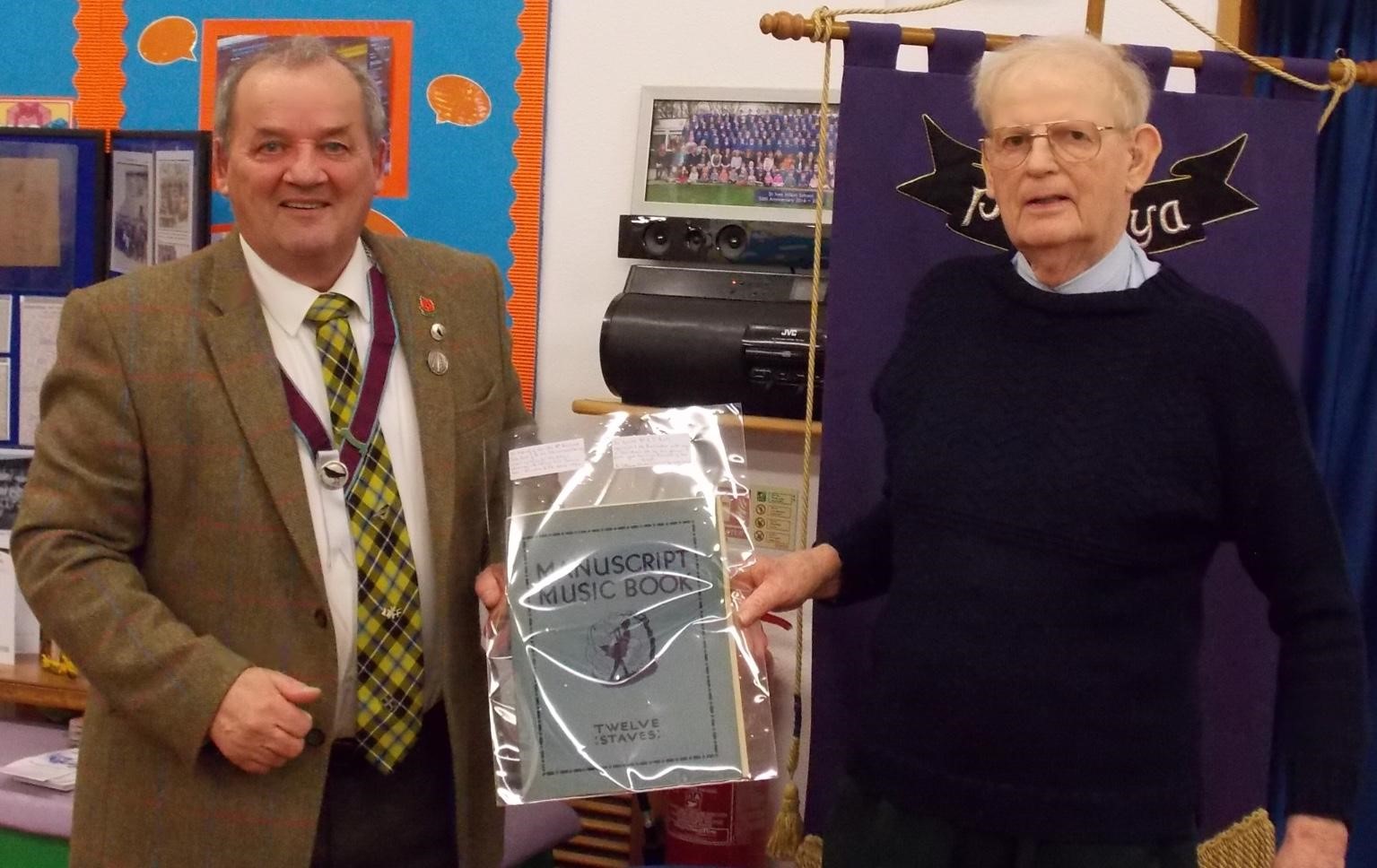
St Ives Old Cornwall Society is now 100 years old and is the founding Society in the Federation of Old Cornwall Societies. At the recent celebratory meeting for Federation members the Chairman, Brian Stevens, returned a manuscript to Trevor Smitheram, the Chairman and President of the Hayle Old Cornwall Society. The manuscript had been borrowed from Hayle Old Cornwall by R. J. Noall in 1930.
St Ives Old Cornwall Society – Social Events & Meetings
20th January 2020
St Ives Old Cornwall 100th anniversary celebrations.
In this, our Centenary year, St Ives Old Cornwall celebrated Members evening by replicating the format of the original meetings. Trelawny was sung after which artefacts, paintings, songs, information, drama and memories of growing up in St Ives were interspersed with readings from the original log books and records kept by the Society which was founded by Robert Morton Nance and Henry Jenner in 1920. Their remit was to record, remember and celebrate the history of life in St Ives and, by setting up other Old Cornwall Societies spread their thoughts and ideas throughout Cornwall. They aimed to ‘Gather ye the fragments that are left, that nothing be lost’. This aim was very successful, as we proved on Monday 20th January 2020.
Paul Turner talked about living at 4, Fore Street, St Ives as a child from 1938 and brought a painting he owns of the backyard to illustrate his talk. Doreen Barber talked about growing up in Halsetown, Sylvia Rule gave an illustrated talk on her life in St Erth and Linda Peters researched and explained, with original images from as early as 1905, her family’s ownership of their cottage at the top of Steeple Lane for over 100 years. Margaret Stevens showed us the Joannie (original carved wooden doll) she inherited from her mother and another doll she has owned since childhood and Stuart Guppy read extracts from an Old St Ives guide book he owns. Mary Quick wrote a dialect story and poem for us to enjoy and Marion Smith found an original Cornish ‘Droll’ in a book she owns called ‘Cledry Plays’, written by Robert Morton Nance for the children of Nancledra School in 1920. The play is called ‘Duffy’, and is based on the fairy tale of Rumplestiltskin. Morton Nance, who was a Grand Bard, incorporated Cornish dialect into the play to raise awareness among the young. ‘Duffy’ was ably re-enacted by Dee and Dave Brotherton and Ivor Frankell. Dee and Dave Brotherton sang in both Cornish and English and Frank Stevens explained, with pyrotechnics and rock samples, the geology of our area and why mining formed such a large part of the local economy.
All this was interspersed with members reading snippets from original records of meetings documented by the Society and Brian Stevens explaining the roll of R.J. Noall and R. M. Nance in establishing the Old Cornwall movement.
This interesting evening was the result of many hours of organisation and research by Margaret and Brian Stevens and thanks must go to them and all members of St Ives Old Cornwall Society who took part in making the evening the success it was.
Click on the video below to see the YouTube video of the centennial commemoration
St Ives Old Cornwall Society – Social Events & Meetings
November 2019 - Argall Photographers 1865 - 1913
The society’s November meeting saw a full house welcomed by the society’s president, Margaret Stevens.
Presenter for the evening was Frank Argall, whose family’s photographic company was founded in 1865 by his great grandfather Frederick. In 1871 Frank’s grandfather took over the company.
With photography still in its infancy much use was made of palladium and nitrate for the plates. Young women wanting to impress a prospective sweetheart could insert a miniature photo unobtrusively into a pocket, and many portraits were taken.
There were extensive views of Cornwall produced as postcards. Frank’s slides showed many Cornish towns of the period. A street in Camborne could be seen with the Wesley chapel nearby, while opposite, a tram was dealing with passengers; the street was busy with shoppers and boys on bikes.
At Banns, near Porthtowan, shoppers were pictured outside Bann’s shop in what seemed to be an arranged photo. In Truro the Cathedral was highlighted, as was the busy river area.
In Newlyn, a fine sailing vessel the ‘Jenny Lind’, owned by the Downing family, headed for the fishing grounds: the boat and its punt were named for the famous Swedish soprano; did she visit Cornwall during a tour perhaps? Further investigation could reveal the answer.
Frank’s slides showed scenes of many more towns and curiosities in Cornwall, even as far as the Tamar where the construction of Brunel’s Royal Albert Bridge was under way during 1857/58. It is impossible to record the variation of Argall Photographs and side-lines which were well advertised from its offices in Truro and in Plymouth. Such scenes from the 19th century are rare, and Frank has cherished them since the company closed in 1965, giving his time to share them with Cornish groups whenever requested. This was a fascinating presentation and much appreciated by his audience, none of whom moved a muscle!
St Ives Old Cornwall Society – Social Events & Meetings
October 2019 - Alan Cox - ‘Cornish Curiosities’
The society’s October meeting was well attended in spite of rough weather. President Margaret welcomed everyone, after which Trelawny was sung. Notice of future events were given, including The Federation Winter Festival to be held at Torpoint on Saturday November 23rd. Local carols can be practised in Fore Street Sunday School on Sunday afternoons during November to prepare for choir engagements in December, including a visit to our society on December 16th. The choir will also be present with the congregation at a carol service in 2020 at Truro cathedral as part of the 100th anniversary celebrations of the founding of the OCS movement which began here in St Ives.
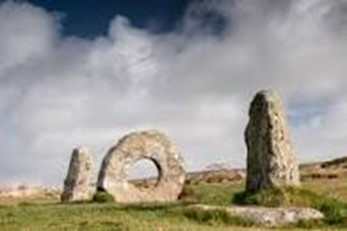
Speaker for the evening was Alan Cox of Falmouth, whose subject was ‘Cornish Curiosities’ shown in slides. Alan’s main focus was on Cornish churches and follies. Plymstock church with its colourful indoor high upstanding panels was furthest north. The show started with slides of Boscastle before and after the flood that devastated the lower part of the town during a violent thunderstorm in August 16th 2004 . Then the small church at St.Hilary, famous not only for its colourful wall paintings, but for one of its vicars, the controversial Bernard Walke, who during his 20 years ministry, wrote a biography and also a religious play in Cornish. There were many other churches shown by Alan, such as the ancient Phillack church on Hayle dunes and Zennor, home of the Mermaid carving. There were slides of the men-an-tol stone through which children were passed to cure their ailments, Kynance Cove where serpentine was mined and Scorrier where titanium was obtained. Most interesting was a curiosity at Nare Head where a small unobtrusive underground bunker, accessed by means of a ladder through what looked like a large metal box, played its part during the last war as a secret listening station.
It is impossible to name all the slides shown, but Alan’s talk introduced us to many places which were unfamiliar and maybe worthy of more visitors in future.
St Ives Old Cornwall Society – Social Events & Meetings
Trevor Smitheram , President of Hayle Old Cornwall, – Hayle and its Heritage.
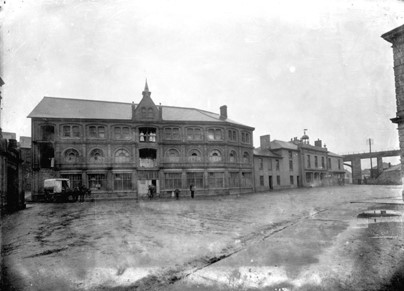
Trevor’s knowledge of his subject is extensive, delivered without notes, and with slides on screen. This became a tour of Hayle, famous for its engineering projects. The first bridge over a railway taking travellers to Truro from Penzance, built in 1857 by Brunel, saw the viaduct erected in 1888, bringing prosperity because of its passage through Hayle carrying manufactured goods from various engineering companies and others. Engineers Harvey’s supplied ship’s engines and shipwrights, built the first rail car in 1804 and the largest ship, the ‘Ramsey’ in 1891: its Foundry is preserved by English Heritage opposite the White Hart inn, which is still recognisable in Foundry Square; much of its history can be found at the Heritage Centre there.
Many slides made for a comprehensive tour of the town, where some streets and buildings can still be identified, such as the White Hart, originally purchased for Trevithick’s wife Jane as a home in 1838, while Richard, with Harvey’s, worked on his rail and road steam locomotives that eventually travelled on rails. One early demonstration on Camborne’s Beacon Hill gave rise to the often sung ‘Going up Camborne Hill’, the locomotive being christened a ‘puffing devil’. Familiar names appeared, such as Harvey’s engineering works that built the first rail car in 1804, and was where Richard Trevithick worked on his locomotive but which often also took him away. J.&.F Pool Ltd , [closed in 2004] was an engineering works that had taken over the Cornish Copper Company which manufactured small household items such as fire irons, clocks and much more . In Foundry Square, workshops were available in what became a Wesley preaching chapel in 1845, [closing in 1967] while slides showed streets that can still be recognised.
Here in 1898 could be found the Cornubia Biscuit works while Boilers Brewery was nearby. The road running past the Heritage Foundry leads to St. Michael’s hospital, where an order of nuns practised medicine in former years. Houses facing west on Carnsew Road still stand, previously usually occupied by prosperous families; fortunately the town had its own Electric Works as well as a theatre and cinema, both long closed.
There is no doubt that the town played an important part in both World Wars. During the 1914-1918 war, the Navy used the sand dunes to hide a dynamite factory that supplied cordite but also stored large amounts of nitro-glycerine. Unfortunately, two tons of this self-detonated in 1916, killing five people, two of them women. It has been reported that windows were broken and the blast heard as far as St.Ives and Penzance, a sad time for the town, which also made munitions, mainly by women, in various locations. Hayle was important during the Second World War, where invasion barges were constructed on the ‘spit’, then transferred to Plymouth.
There was much more detail in this talk as Trevor provided dates, which added to the understanding of times past. This was an interesting talk, enjoyed by everyone as Trevor was a clear speaker who captured his audience.